Written by Jeremy McDonald, Founder, We Are Pioneers
I quit my role as CEO of a 50-person agency to go all in on AI deployment. Not because I thought the industry was dying, but because I saw what was coming and knew I wanted to be on the frontlines of the AI revolution.
Every revolution looks the same when you zoom out far enough. In 1811, workers smashed machines because they feared for their livelihoods. The machines did take their jobs. Then they created more. In 1995, businesses dismissed the internet as a fad. It didn’t replace business. It transformed it. AI is following the same pattern: fear, resistance, adoption, transformation, new normal. We’ve seen this film before. We’re just living through the uncomfortable middle bit.
The difference this time is speed. What took the internet a decade is happening in months.
Three waves, one trajectory
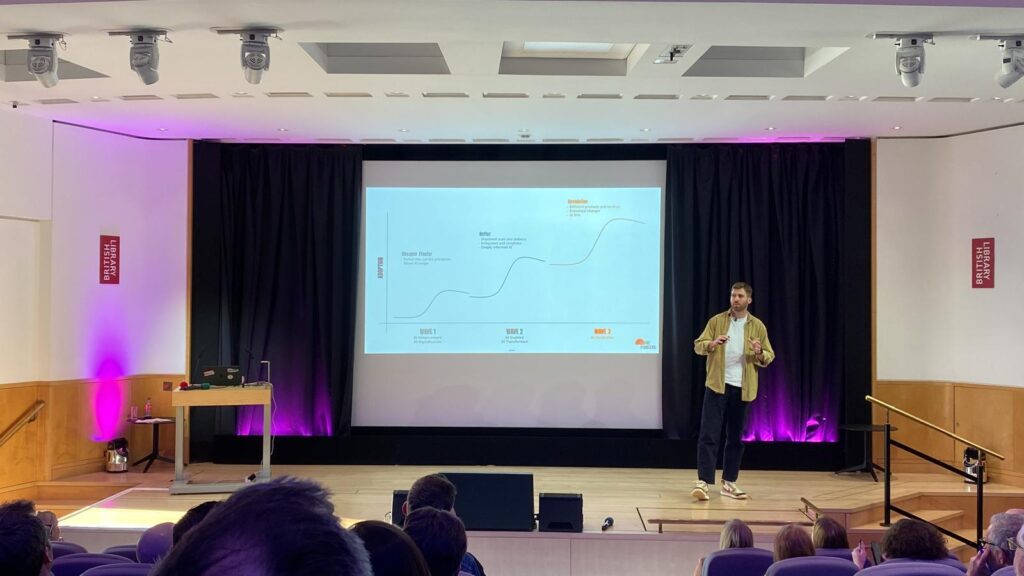
When I train teams on AI, I frame adoption in three waves.
Wave 1: Cheaper, faster. AI bolted onto your current workflows. Faster transcription, basic drafts, simple lookups. Admin disappears. Output goes up. Most teams are here, and it’s a good start, but it’s not the destination.
Wave 2: Better. New processes at greater scale. Automated reporting, end-to-end campaign processing, and research at a depth that wasn’t possible before. This is where teams stop using AI as a shortcut and start using it as a capability.
Wave 3: Revolution. Different products and services entirely. Personalised client experiences built on insights that didn’t previously exist. AI-first thinking, not AI-assisted. This is where the industry is heading, and the organisations that get there first will define the next era.
The question isn’t whether your industry will go through all three. It’s which wave you’re in right now and what you’re doing to move to the next one.
Your process is your competitive advantage
Here’s the golden nugget most teams miss: your USP is not AI. Everyone has access to the same tools. Your USP is your process.
The teams winning with AI are the ones who understand their own workflows deeply enough to rebuild them. They know which tasks are repetitive, which decisions follow patterns, and where human judgment genuinely adds value versus where it’s just habit.
AI doesn’t replace that knowledge. It amplifies it. If your process is strong, AI makes it scalable. If your process is weak, AI just scales the problems.

Experimentation is the only strategy
Nothing works the first time. Your first prompt won’t be perfect. Your fifth might not be either. That’s the process, not the problem.
The teams I see making real progress share a few habits: they expect failure and iterate fast. They change one variable at a time. When something works, they save it, version it, and share it with the team. When something fails, they treat it as information rather than a reason to stop.
Measure the difference. Time the task before and after. Track quality. If it’s not faster or better, change the approach. Each experiment compounds. Four weeks of consistent testing, and your outputs will be unrecognisable from where you started.
The opportunity is not optimisation. It’s a redesign.
The biggest mistake I see is teams trying to make their existing way of working 10% faster. The real opportunity is asking whether the way you work should exist at all in its current form.
That shift in thinking, from optimisation to redesign, is what separates the teams that will lead from the ones that will follow.
AI training isn’t about learning a tool. It’s about learning to think differently about your work, your processes, and your value. The tools will keep changing. The thinking is what sticks.

Jeremy McDonald is the Founder of We Are Pioneers, an AI consultancy that trains, runs transformation programmes and deploys AI systems for leading brands. He delivers AI training programmes through the PA Media Academy.